
Here we are on May 15, about three and a half days since we planted the first 16 pepper plants on Monday evening, and about three days after we finished planting the second 16 plants Tuesday morning.
Previously: Planting Day. Or, start from the beginning of The Pepper Project.
The focus these last three days has been on watching for signs of transplant shock. That can often be a killer for young plants in our hot Antiguan climate. So, we’ve been checking moisture levels daily, as well as gauging the appearance of our little guys.
A side bonus of having to split up the planting is that we have the opportunity to see if there’s an appreciable difference in the group that was planted Monday evening and those that were planted Tuesday morning.
The thought would be that the evening planted group might have the advantage of overnight recovery time. Meanwhile, the Tuesday morning group was thrown almost immediately into the hot Antiguan sun, thus increasing their odds of some shock effects.
Well here we are, three days in, and it seems there’s been no transplant shock at all yet, in either group. We’re not out of the transplant woods yet, but so far, it’s a great start.
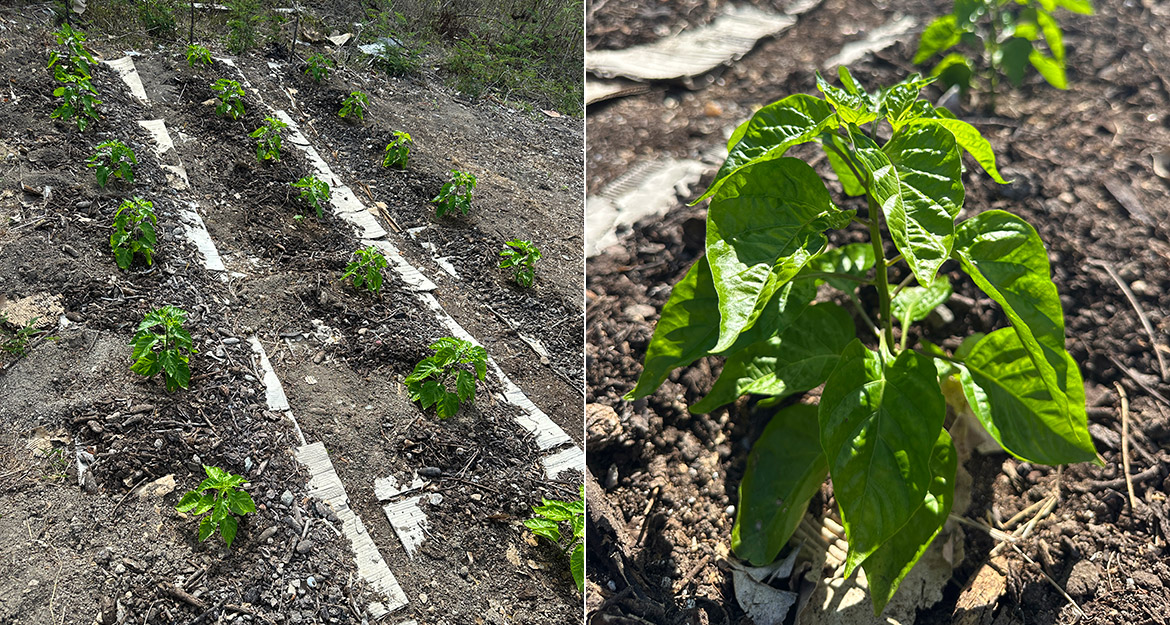
This is what we looked like after 24 hours. Not too shabby, huh?
They looked about as good as we could realistically hope for after their first day in the sun: the leaf posture is still open, the stems are upright,
the new growth tips are intact, and there’s very little of that “wrinkled surrender” look that stressed peppers often get after transplant.
It appears that our moisture control system of cardboard and compost overs is doing its job, thankfully.
Probably the greatest risk at this early stage is overreacting. Pepper plants can be little drama queens, especially when they’re recently transplanted. In the midday sun, they can look like they’re dying a torturous death, but by 5pm, they’re standing up again like nothing happened.
So, when you see them do that midday droop, looking like they’re on death’s door, there’s the urge to douse them with water, and revive your poor suffering plants. But that can create bigger problems in a system that’s already adequately moist below the surface.
The urge is to be resisted. Trust the moisture meter. It won’t lead us astray.
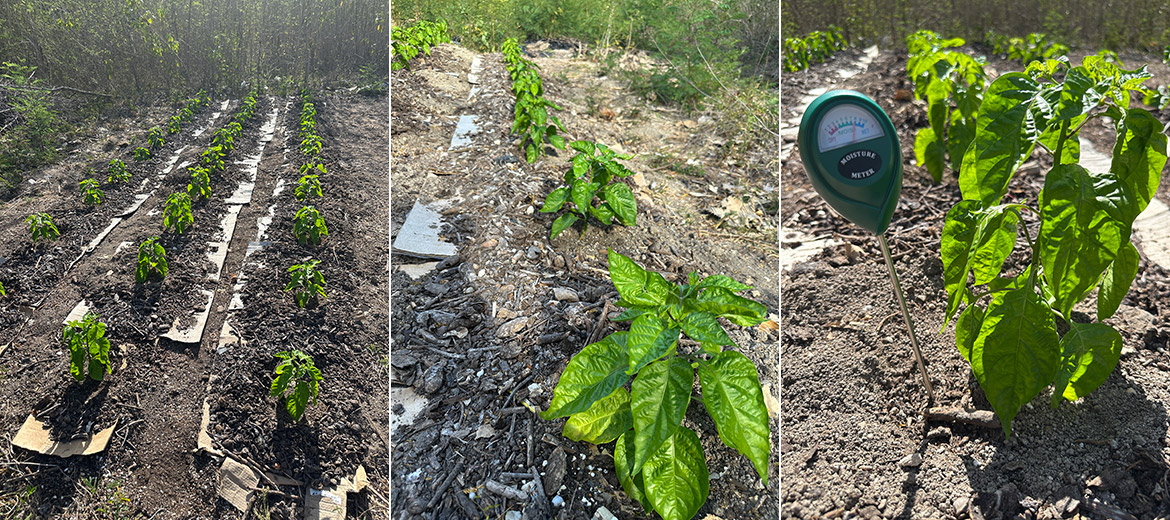
Here we are on Thursday, May 14… two full days in, and we see more of the same…
The leaf color is rich and healthy, the new growth tips are active, the stems are upright and sturdy, there’s no obvious transplant-collapsed plants, and there’s no major curling, bleaching, or limpness.
And the meter is still showing strong moisture below the surface, which is most important.
Our moisture-retention theory is looking increasingly correct. The cardboard + overs + minimal disturbance combo is behaving almost like a sponge cap over the soil. And because we didn’t till, we likely preserved a lot more existing soil structure than if we had.
Right now, restraint is our superpower. Watch and wait.
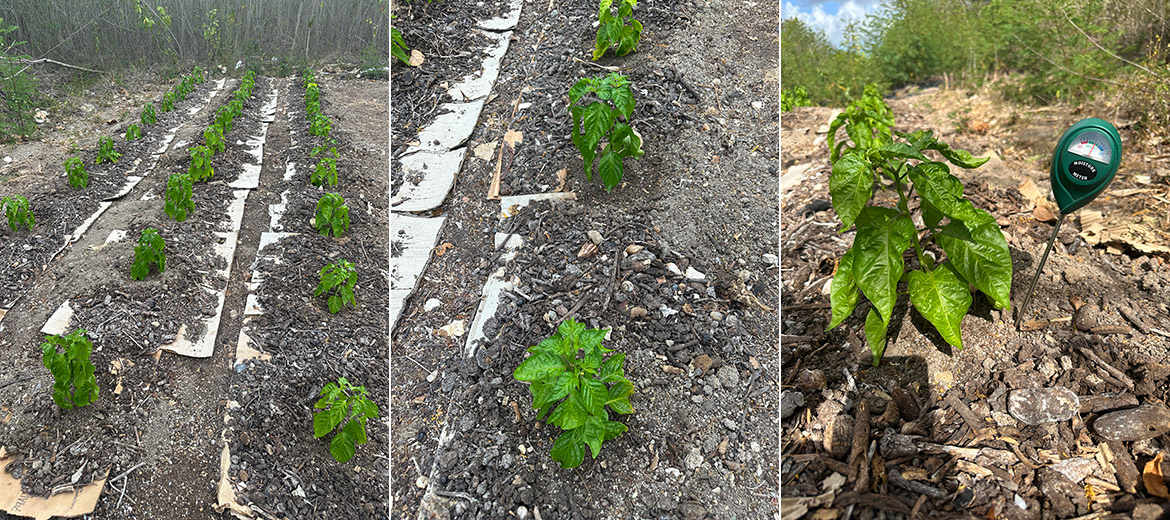
And here we are on the morning of Friday, May 15… three days in and still looking good.
These are freshly transplanted Scotch Bonnets sitting in exposed tropical conditions, planted into what was essentially scrubland soil just weeks ago… and this is the condition of the crop?
Seems like we’re crossing from, “maybe this works,” into, “ok, there’s definitely something working here”.
A few things we’re noticing now that are different from Day 1: Several plants already appear slightly fuller. Some tops are actively pushing new growth despite the transplanting. Leaf sheen is strong, color is consistent overall, and the rows are beginning to visually stabilize instead of looking freshly planted.
That last one matters more than people realize. Newly transplanted rows usually look awkward and tense for a while. These already look like they’ve started integrating into the site.
We’re not out of the woods yet… transplant shock can take up to a week to really show up. But things are looking good.
Our system appears to be working.
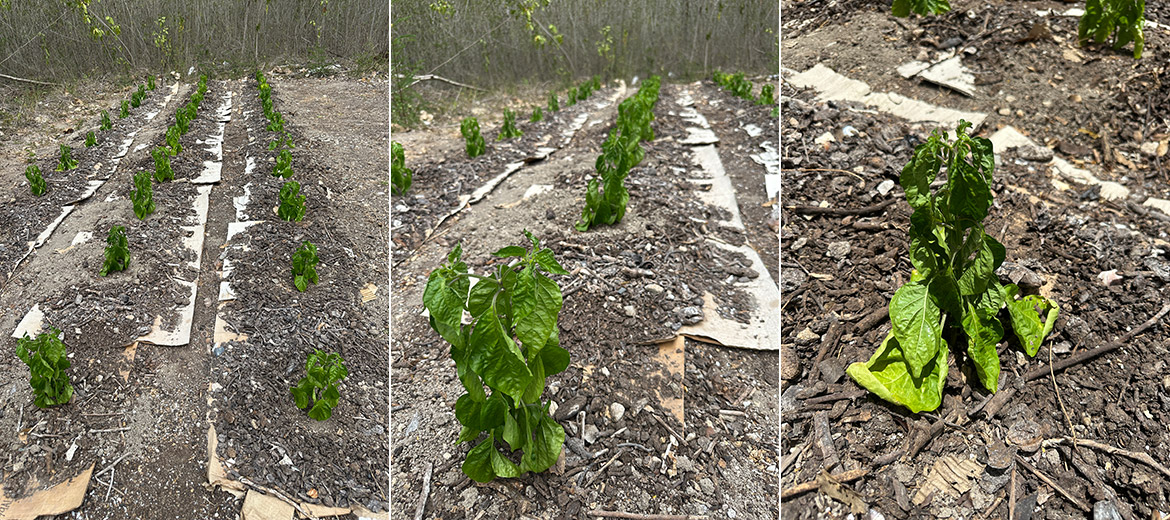
We happened to hang out on site to about 12:30pm, peak midday sun, and things are looking droopy, for sure. This is when the temptation to soak these poor suffering babies is strongest, especially for that last one.
Most importantly, the moisture meter readings are still well in the ‘moist’ range. But other positive signs include: the entire field is behaving similarly, like it’s a coordinated response to the brutal overhead sun, not isolated shock effects that we would expect. Also, they all have decent color, no crispy margins, no dull gray-green stress tone, no total stem flop. The leaves are hanging, but they’re not looking empty.
This is probably close to the hardest environmental moment these plants have faced so far, and they seem to be saying, “this is unpleasant, but survivable.”
Even the most stressed one in that last pic isn’t screaming ’emergency’ yet.
So, we wait and monitor. We’ll be back tomorrow to check on things, but after three full days out here, things seem to be working.
Next up: The first watering.