
Hello again! Welcome to the ninth segment in our series on the Life of a Batch. In this segment, we’ll walk through the seventh turn of our batch. But more importantly, we’ll look at the temperature numbers up to this point, and talk a bit about the patterns that are emerging.
Previously:
We went through turn number six, looking at the subtle progress from the previous turn.
Today is Monday, April 20… 12 days since we last turned the batch, and 77 days since we started the batch. Let’s check on how things have progressed, and then we’ll get to some analysis.
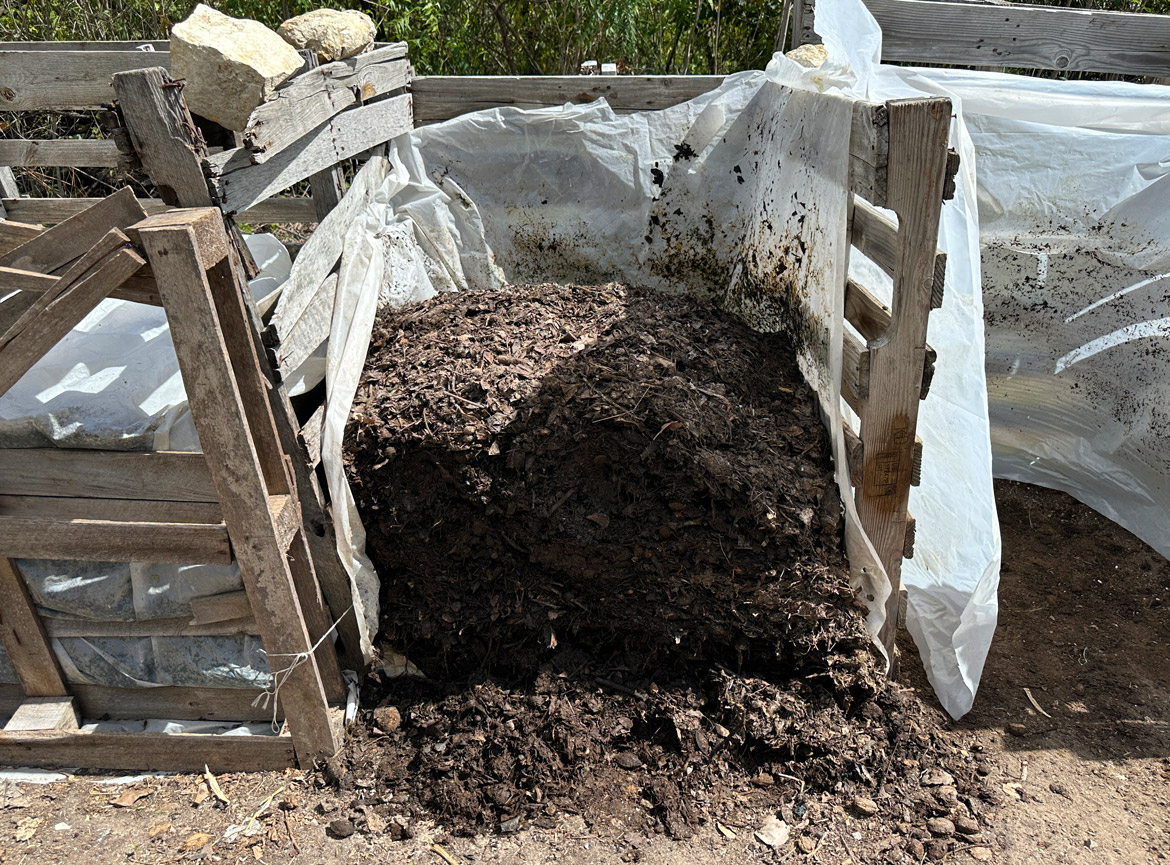
Here’s how we’re looking. As you can see, We’ve shrunken a bit more, but not much. From a distance, it looks very similar to the last time.
As for the temperatures this round… the day after the last turn, it dropped to 113°F (45°C), a 14°F (8°C) drop from the day of the turn. Five days later, on April 14, the temperature for this round peaked at 123°F (51°C), then slowly cooled over the last six days to today’s temperature of 117°F (47°C). Our compost is gradually transitioning out of the thermophilic phase, and into the mesophilic phase.
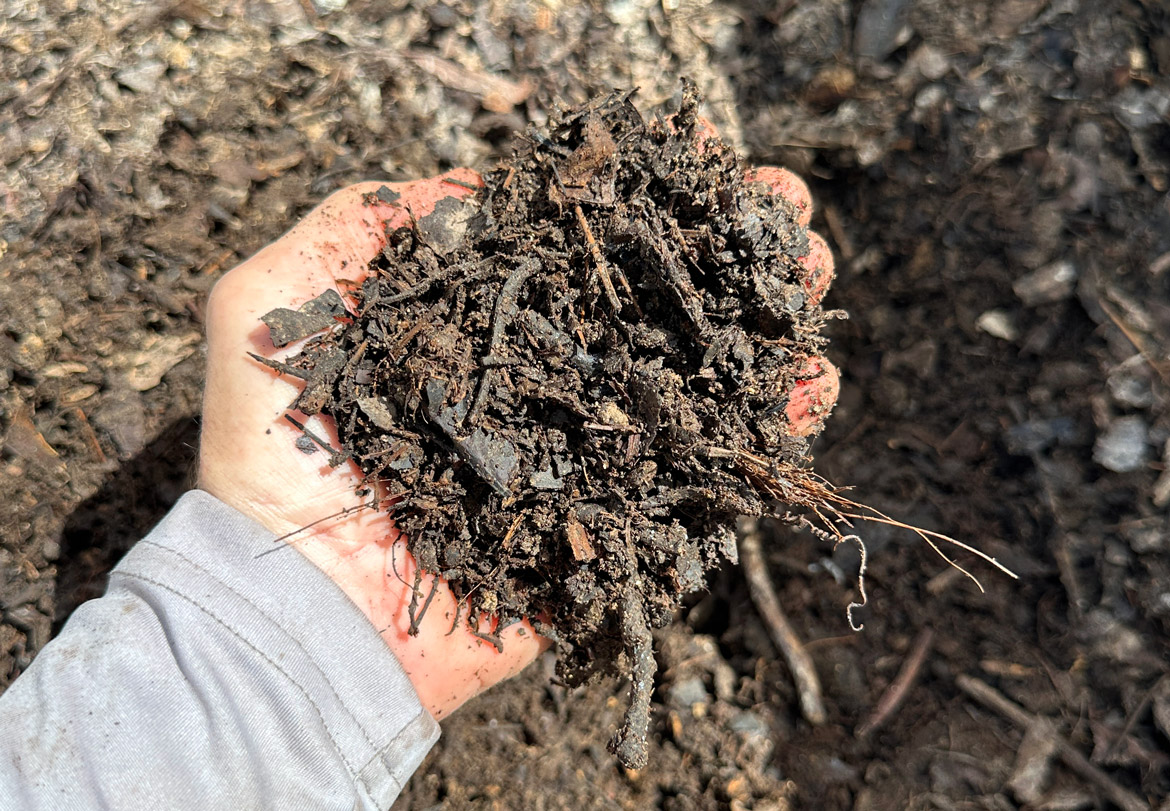
Looking at the material up close, you can see that it’s still chunky, but it’s becoming more homogeneous. It’s harder to recognize the original components of grass, leaves, and food. Now, it’s just chunky brown stuff. And over the next several weeks, it will gradually become less and less chunky.
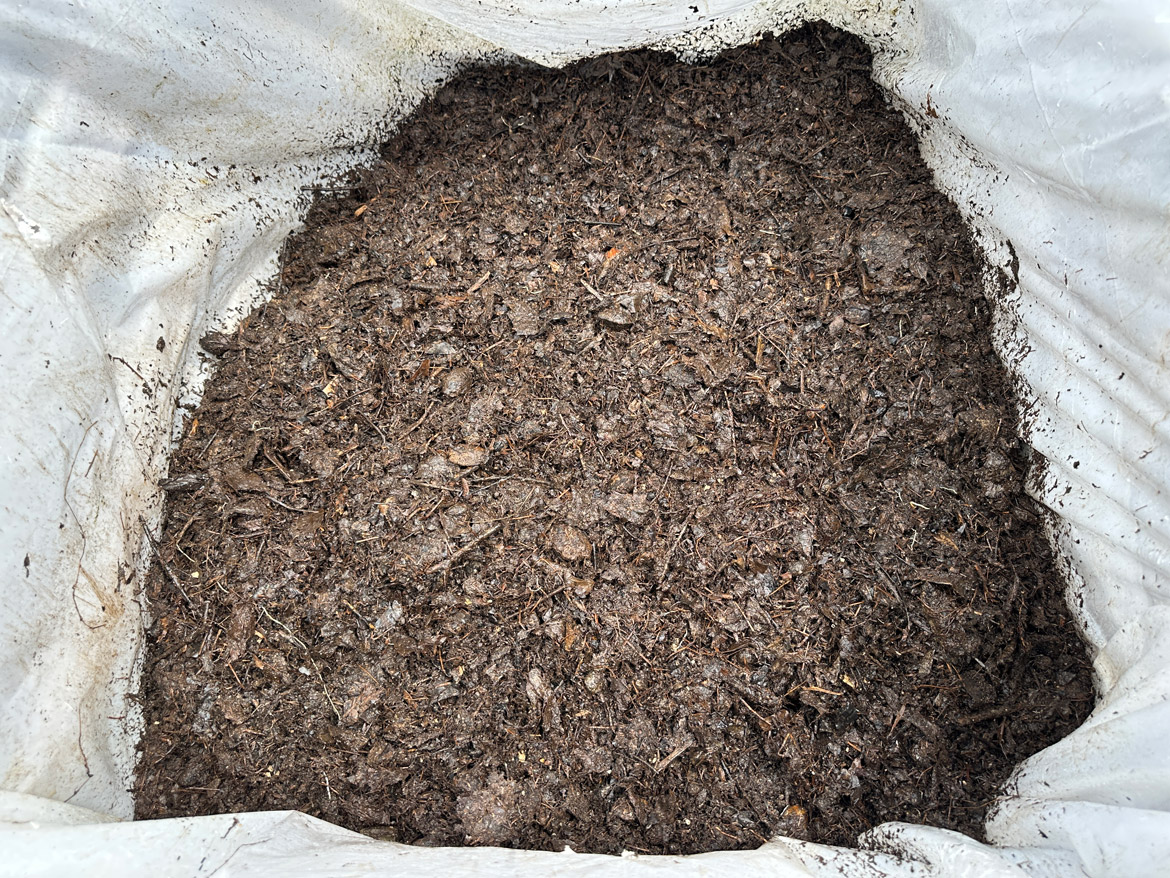
If you’ve been following along up to this point, you already know the drill. We take down the material with the pitchfork, mixing stuff that was on the outside of the pile to the inside of the pile. We also break apart clumps, aerating the mixture, and we add water throughout, as we move it to the next bay. Here you can see everything moved and thoroughly wet down, before we wrap it up for the next segment of decomposition.
Now, let’s talk numbers…
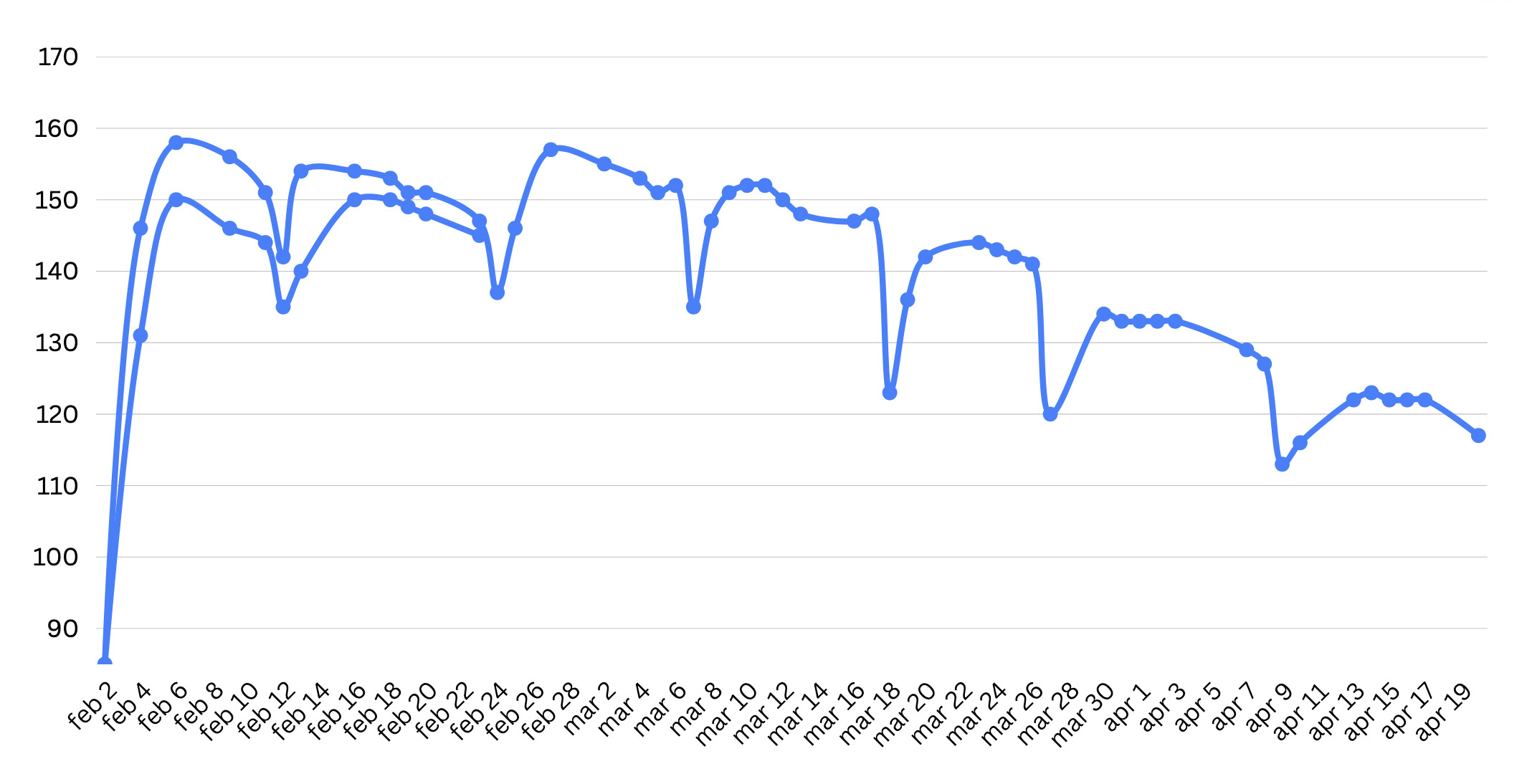
We’ve decided to graph this out, so you can get a visual sense of the progression through the temperature readings.
As you can see, we started the graph on February 2. In the beginning we have two lines because the batch was setup into two bays, and we take our temperatures from both bays each time. We probably could have simplified the chart by averaging the two, but for accuracy’s sake, we kept them separate.
It also shows how uneven early composting can be, as we have pockets of various materials in the piles… grass here, leaves there, food in between… with material being chunkier and less homogeneous.
When we assembled the batch, we start the graph with an ambient temperature of about 85°F (29°C).
After that, you see the temperature rise rapidly over the first few days, then plateau, then slowly taper off.
The first hard dip comes on Feb 12, the day after our first turn. The reason for sudden drop in temperature is, when we turn a pile, it’s broken apart, mixed, aerated, and wet down. Heat escapes and water cools. However, once it’s reassembled into the next bay, the microbiology quickly goes back to work, and the temperature rises accordingly, usually hitting it’s new peak within a few days.
You can see this pattern repeat over the next segment.
Within a few days (by Feb 16), each bay’s material hits its peak temperature, 150°F (66°C) and 154°F (68°C) respectively, then gradually cools until the next turn. You can see the second turn on Feb 23. That’s where we combined both bays into one, so we just have a single line from then on.
The next day, there’s the drop in temperature again to 137°F (58°C). Then the batch heats up again, reaching its peak for this segment of 157°F (69°C), then fading off again until the next turn.
And the pattern repeats over and over. After each turn, the temperature dips significantly, then heats back up fairly rapidly to plateau, then slowly cool off over the following days. However, each subsequent plateau is a little below the previous. This is how we know the batch is progressing.
Eventually, it won’t peak much over 100°F (38°C). That’s when we know it’s about done and it’s time to screen it.
Next up:
Turn number eight. We’re moving into the final month or so, when the material starts to look like the real thing.